
 By giles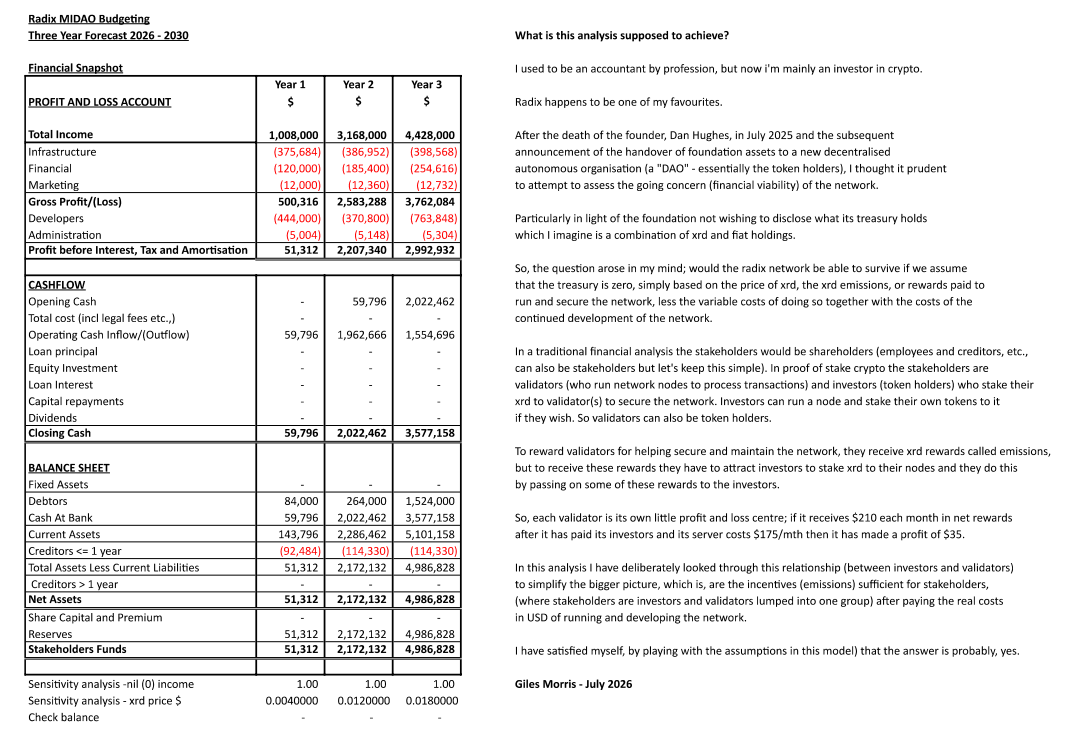
Three Year Forecast 2026 – 2030
Link to model: https://docs.google.com/spreadsheets/d/13OWtuGDAWyadAFmYtYrGxOBrHd1diYJJ/edit?usp=sharing&ouid=111125018768038216422&rtpof=true&sd=true
Download model: https://gilesmorris.me/wp-content/uploads/2026/07/radix-1.xlsx
X post: https://x.com/gilesmorris/status/2082110308252778715?s=20
What is this analysis supposed to achieve?
I used to be an accountant by profession, but now i’m mainly an investor in crypto.
Radix happens to be one of my favourites.
After the death of the founder, Dan Hughes, in July 2025 and the subsequent
announcement of the handover of foundation assets to a new decentralised
autonomous organisation (a “DAO” – essentially the token holders), I thought it prudent
to attempt to assess the going concern (financial viability) of the network.
Particularly in light of the foundation not wishing to disclose what its treasury holds
which I imagine is a combination of xrd and fiat holdings.
So, the question arose in my mind; would the radix network be able to survive if we assume
that the treasury is zero, simply based on the price of xrd, the xrd emissions, or rewards paid to
run and secure the network, less the variable costs of doing so together with the costs of the
continued development of the network.
In a traditional financial analysis the stakeholders would be shareholders (employees and creditors, etc.,
can also be stakeholders but let’s keep this simple). In proof of stake crypto the stakeholders are
validators (who run network nodes to process transactions) and investors (token holders) who stake their
xrd to validator(s) to secure the network. Investors can run a node and stake their own tokens to it
if they wish. So validators can also be token holders.
To reward validators for helping secure and maintain the network, they receive xrd rewards called emissions,
but to receive these rewards they have to attract investors to stake xrd to their nodes and they do this
by passing on some of these rewards to the investors.
So, each validator is its own little profit and loss centre; if it receives $210 each month in net rewards
after it has paid its investors and its server costs $175/mth then it has made a profit of $35.
In this analysis I have deliberately looked through this relationship (between investors and validators)
to simplify the bigger picture, which is, are the incentives (emissions) sufficient for stakeholders,
(where stakeholders are investors and validators lumped into one group) after paying the real costs
in USD of running and developing the network.
I have satisfied myself, by playing with the assumptions in this model) that the answer is probably, yes.